
The Brutal Truth About Startup Failure
Most startups do not fail because of bad ideas or weak products.
They fail because of startup branding mistakes that destroy trust before customers even try the product.
From unclear positioning to inconsistent brand identity, startup branding mistakes silently block growth, reduce conversions, and weaken credibility in competitive markets.
Understanding these branding failures—and fixing them with a strategic branding approach—is essential for any startup that wants to scale sustainably.
Every year, thousands of startups are launched with excitement, ambition, and innovation.
And every year, most of them quietly disappear.
Not because the founders weren’t smart.
Not because the product didn’t work.
Not even because the market didn’t exist.
They fail because nobody trusted them enough to care.
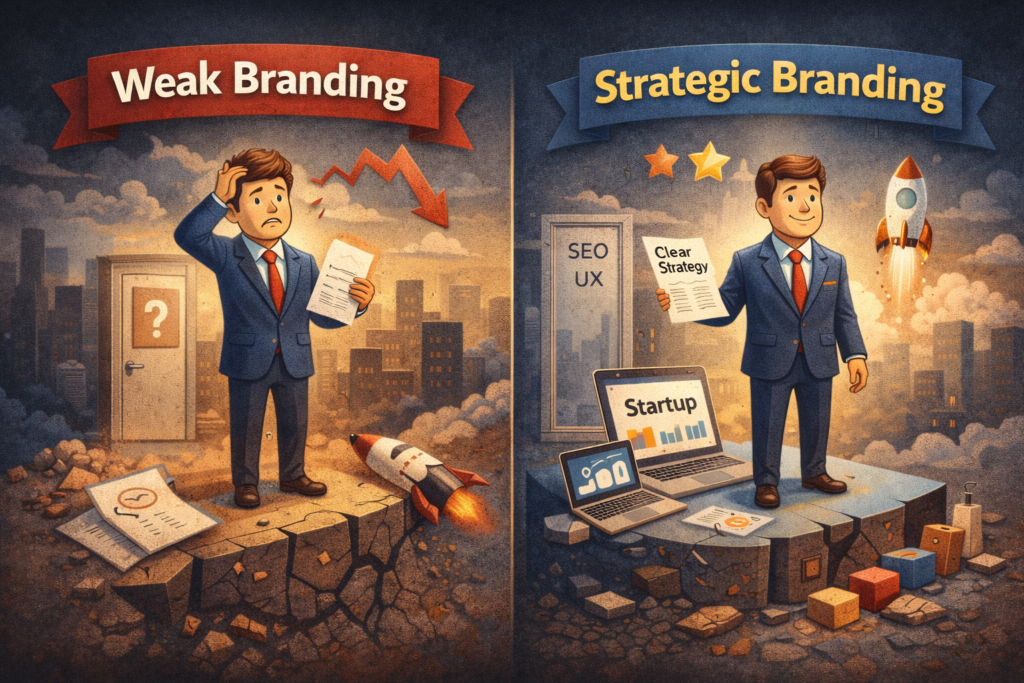
This is where branding enters the conversation—and where most startups get it dangerously wrong.
Branding is often treated as:
- A logo
- A color palette
- A website task for “later”
- Something to do after revenue
But in reality, branding is the first signal of trust your startup sends to the world.
If that signal is weak, inconsistent, or confusing, growth becomes an uphill battle—no matter how good your product is.
In this blog, we will break down:
- Why most startups fail at branding
- The most common branding mistakes founders make
- What strategic branding actually means
- How branding becomes a growth engine—not a design expense
This is not theory. This is branding from the lens of real business outcomes.
Most early-stage founders unknowingly make startup branding mistakes that damage trust.
The Biggest Branding Myth That Destroys Startups
“Our product is strong. Branding can wait.”
This single belief has killed more startups than poor funding or competition.
Here’s the reality:
Your product does not speak for itself.
Your brand speaks before your product ever gets a chance.
Before users:
- Try your product
- Book a call
- Sign up
- Invest
- Recommend you
They subconsciously ask:
- Is this company trustworthy?
- Does this look professional?
- Do they understand my problem?
- Are they serious or just experimenting?
All of those questions are answered by branding, not features.
Startup branding mistakes often start with unclear positioning and weak messaging.
What Branding Actually Means (Not the Internet Version)
Let’s be clear.
Branding is not:
- Just a logo
- Just visuals
- Just a website
- Just marketing
Branding is:
The perception people form about your business when you are not in the room.
It includes:
- Your positioning
- Your messaging
- Your visual consistency
- Your tone of voice
- Your user experience
- Your credibility signals
- Your clarity of purpose
A startup without strategic branding is like a person walking into a boardroom without introducing themselves—expecting people to trust them instantly.
Avoiding startup branding mistakes early saves huge marketing costs later.
Why Most Startups Fail at Branding (Core Reasons)
1. They Start with Design, Not Strategy
Most startups begin branding with questions like:
- What should our logo look like?
- What colors are trending?
- Can we copy this competitor’s style?
They skip the most important questions:
- Who exactly are we for?
- What problem do we own?
- Why should anyone choose us?
- What emotion should people feel?
Without strategy, design becomes decoration—not communication.
These startup branding mistakes are common across tech and service startups.
2. No Clear Brand Positioning
If your startup sounds like:
- “We provide quality solutions”
- “We offer end-to-end services”
- “We are innovative and customer-focused”
Then you don’t have positioning.
You have noise.
Positioning means owning a clear space in the customer’s mind.
If people can’t explain your startup in one clear sentence, they won’t remember you—and they won’t buy from you.
3. Inconsistent Brand Experience Everywhere
One of the fastest ways to lose trust is inconsistency.
- Website looks premium
- Social media looks casual
- Pitch deck looks outdated
- Emails sound robotic
This creates confusion.
Strong brands feel cohesive, even when seen in pieces.
Consistency is not about perfection—it’s about recognition and reliability.
4. Copy-Paste Branding from Competitors
Many startups subconsciously clone:
- Website layouts
- Messaging styles
- Color palettes
- Buzzwords
The result?
You blend into the market instead of standing out.
If your brand looks like everyone else, users will choose:
- The cheaper one
- The older one
- The more famous one
Originality in branding is not creativity—it’s survival.
5. Treating Branding as a One-Time Task
Branding is not:
“Let’s do branding this month and move on.”
Branding is a living system that evolves with:
- Your product
- Your audience
- Your market maturity
- Your vision
Startups that “set and forget” branding slowly lose relevance.
The Hidden Cost of Poor Branding
Bad branding doesn’t always look like failure.
Sometimes it looks like:
- Low conversion rates
- High bounce rates
- Price resistance
- Long sales cycles
- Weak investor interest
- Constant need to explain yourself
These are branding problems disguised as marketing or sales issues.
When branding is weak:
- Ads cost more
- SEO converts less
- Sales teams struggle
- Growth feels forced
Understanding startup branding mistakes helps founders build stronger brands.
What Is Strategic Branding (The Right Way)
Strategic branding aligns business goals, audience psychology, and brand expression.
It answers three core questions:
1. Who Are We Really For?
Not “everyone.”
Not “all businesses.”
Clear audience definition changes everything—from messaging to design to content.
2. What Do We Want to Be Known For?
Not features.
Not services.
But outcomes and identity.
Strong brands are remembered for:
- Clarity
- Confidence
- Focus
3. How Do We Consistently Communicate This Everywhere?
Across:
- Website
- Content
- Social media
- Sales material
- Product UX
Consistency builds trust faster than any ad campaign.
How Strategic Branding Fixes Startup Growth Problems
Branding Builds Trust Before Marketing Starts
People don’t click ads because of logic.
They click because of perception.
Strong branding:
- Increases click-through rates
- Improves SEO engagement
- Builds credibility instantly
Branding Reduces Customer Confusion
Clear branding:
- Explains what you do
- Who it’s for
- Why it matters
Confused users don’t convert.
Clear brands win.
Branding Improves Pricing Power
Well-branded startups:
- Charge more
- Negotiate less
- Attract better clients
People pay premiums for brands they trust.
Branding Attracts Opportunities Automatically
Investors, partners, talent, and media judge you before speaking to you.
Strong branding opens doors before conversations begin.
Real-World Startup Branding Example (Conceptual)
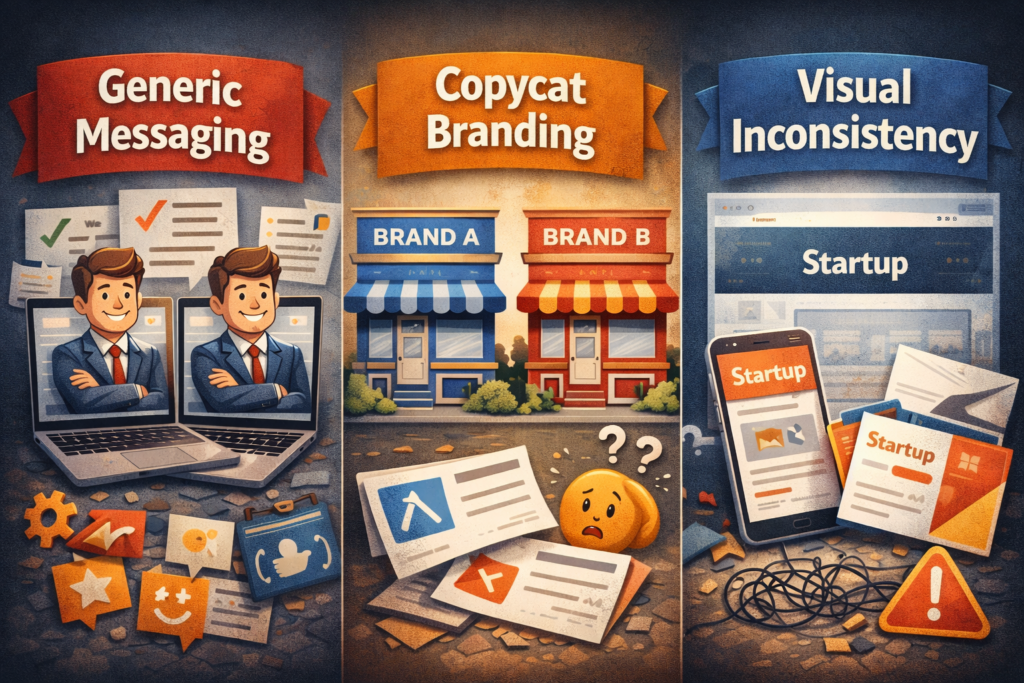
Two startups. Same product. Same pricing.
Startup A
- Generic website
- Vague messaging
- No story
- Inconsistent visuals
Startup B
- Clear positioning
- Strong narrative
- Consistent identity
- Confident tone
Startup B grows faster—not because of better features, but because:
People understand and trust them faster.
Branding Is a Growth Asset, Not a Cost
Founders often ask:
“Is branding really worth the investment?”
The better question is:
“How much is poor perception costing us every day?”
Branding compounds over time—just like trust.
When Should a Startup Invest in Branding?
The answer is simple:
- Before scaling
- Before heavy marketing spend
- Before fundraising
- Before global expansion
The earlier branding is done right, the less correction is needed later.
How We Approach Startup Branding at The Branding Skroll
We don’t design brands.
We build brand systems.
Our approach focuses on:
- Strategic clarity
- Market positioning
- Scalable brand identity
- Conversion-focused communication
- Long-term authority building
Branding is not about looking good.
It’s about being remembered, trusted, and chosen.
Final Thoughts: Branding Is the Foundation, Not the Finish Line
Most startups don’t fail because they lack ideas.
They fail because they fail to communicate value clearly.
Strategic branding ensures:
- You are understood
- You are trusted
- You are chosen
And in today’s competitive digital world, that is everything.
If you are a startup or growing business struggling with:
- Low trust
- Poor conversions
- Weak brand recall
- Confused positioning
It’s time to stop guessing.
Build a brand that works before you scale.
📩 Connect with The Branding Skroll and start with clarity.